We Learn to Pass Exams, But Do We Learn to Understand?
By team zEDXplo
•
•
9 min read
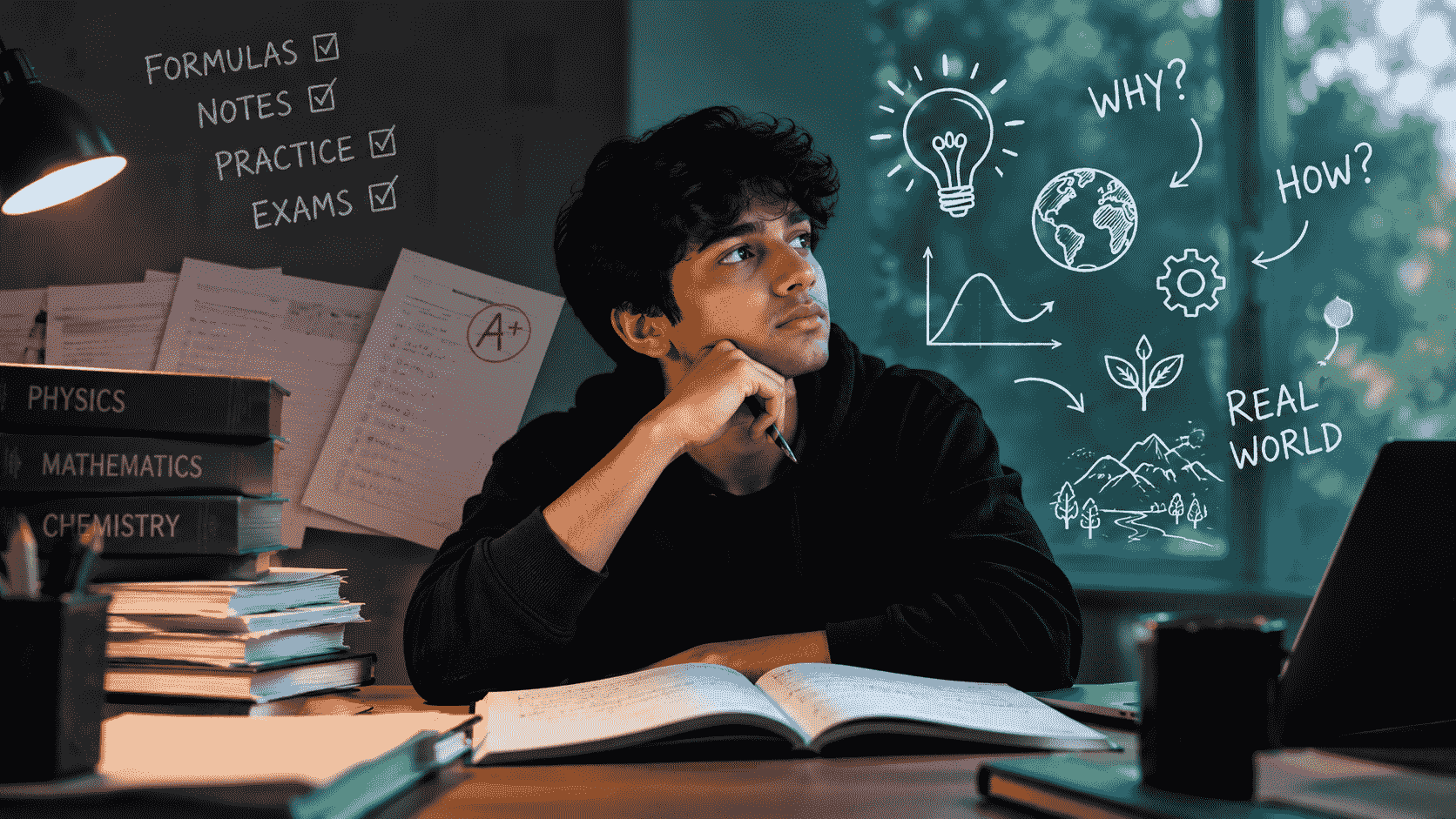
Think about the last time you studied something for an examination. You probably read the chapter, highlighted important points, memorised a few definitions, solved some questions and eventually wrote the exam.
You might even have scored well.
But here is a question worth thinking about: How much of what you studied can you actually use today?
Can you explain the concept without looking at your textbook? Can you connect it to something happening around you? Can you use that knowledge to solve a problem you have never encountered before?
For many students, the honest answer might be uncomfortable.
We spend years learning different subjects, completing assignments and preparing for examinations. Yet, somewhere along the way, learning often becomes less about understanding something and more about remembering enough to reproduce it.
And perhaps that is one of the biggest problems with the way we approach education.
When learning becomes a race for marks
There is nothing inherently wrong with examinations. They help evaluate progress, encourage discipline and provide a way to assess what students have learned.
The problem begins when marks become the primary reason for learning.
Consider a student studying physics. They learn Newton's laws, memorise the definitions, practise numerical problems and reproduce the explanations in an examination.
They may score 95%.
But when they see a bicycle slowing down after the brakes are applied, can they explain what is happening using the laws they studied?
The knowledge is there, at least on paper. But the connection between the textbook and the real world may be missing.
This is where something important gets lost.
A student can remember a definition without understanding the idea behind it. They can solve a familiar problem without knowing why a particular method works. They can complete an entire syllabus without developing the ability to explore what they have learned.
Education starts feeling like a destination — finish the chapter, pass the examination, move to the next subject.
But learning was never supposed to be just about finishing chapters.
Knowing something and understanding something are different
Imagine someone tells you that an antenna receives electromagnetic waves.
You memorise the statement. You can write it in an examination. You might even explain it in a few sentences.
But do you know what actually happens?
What is an electromagnetic wave? How does an antenna interact with it? How does that interaction produce an electrical signal? How does a radio receiver turn that signal into sound?
Each question opens another layer of understanding.
This is the difference between knowing a statement and understanding the mechanism behind it.
Knowing gives you information. Understanding helps you make sense of that information.
And when you understand something deeply, you begin to see connections that were not obvious before.
You start recognising physics in everyday technology, mathematics in patterns around you, chemistry in ordinary materials and engineering in the systems you use every day.
The subject stops being something confined to a textbook. It becomes a way of interpreting the world.
The missing connection between classrooms and the real world
One reason students struggle to apply knowledge is that concepts are often taught in isolation.
We learn mathematical formulas without always exploring where they come from or why they are useful. We study scientific principles without consistently connecting them to the devices and systems built around those principles.
A chapter ends, an examination follows, and a new chapter begins.
But the real world does not work in separate chapters.
A smartphone, for example, is not simply a product of electronics. It brings together physics, communication systems, computer science, mathematics, material science and engineering.
Understanding how it works requires connecting ideas from different fields.
This ability to connect knowledge matters because real-world problems rarely arrive labelled with the subject or chapter required to solve them.
You have to recognise the problem, identify relevant ideas, connect them and figure out how to use what you know.
That requires more than memorisation. It requires understanding, reasoning and curiosity.
Are we really preparing students for the future?
Think about the world students are entering.
Technology is evolving, industries are changing and entirely new professions are emerging. Information that once took hours to find is now available within seconds. Artificial intelligence can explain concepts, generate answers, write code and solve many problems.
In such a world, simply possessing information is becoming less valuable than knowing what to do with it.
A student might know the formula for calculating velocity, but can they identify when to use it in an unfamiliar situation?
Someone might memorise the definition of artificial intelligence, but can they recognise its limitations, question its output and decide when its suggestions should not be trusted?
These abilities depend on something deeper than remembering information.
They require the ability to think, question, analyse, connect and make decisions.
And these abilities do not develop simply by completing a syllabus. They develop when students are given opportunities to work with ideas, explore different possibilities, make mistakes and figure things out.
The challenge for education is not just to prepare students for the next examination. It is to prepare them for situations that have no textbook answers.
Curiosity is not a distraction from learning
Think about how a child learns about the world.
A child sees a ceiling fan rotating and wonders why it moves. They see a rainbow and wonder how different colours appear. They notice that a ball eventually stops rolling and begin asking why.
Nobody needs to announce that it is time to study physics. The questions emerge naturally from observing the world.
One question leads to another.
Why does the fan rotate? What makes the motor work? How does electricity produce motion?
This is curiosity turning into exploration.
Yet, as students progress through formal education, learning can gradually become more structured around prescribed chapters, expected answers and examination schedules.
Curiosity is not necessarily lost, but it often gets pushed aside by the pressure to finish the syllabus.
We should not mistake this for a lack of interest among students. Sometimes, students simply do not get enough opportunities to follow their questions.
A question that goes beyond the textbook is not necessarily a distraction. It might be the beginning of genuine understanding.
So, what should meaningful learning look like?
It does not mean removing examinations, abandoning textbooks or making every lesson entertaining.
It means changing what we consider a successful learning experience.
A student who studies electricity should not stop at memorising definitions of current, voltage and resistance. They should gradually develop the ability to understand how these quantities interact in an actual circuit.
A student learning mathematics should not only practise applying formulas. They should explore the relationships behind those formulas and recognise where mathematical ideas appear in real situations.
A student studying biology should not merely remember the names of different organs. They should understand how those organs work together as a system.
There are a few simple habits that can make a meaningful difference:
- • Ask why, not just what: Whenever you encounter a new concept, look beyond its definition. Try to understand why it exists and what makes it work.
- • Connect ideas: Explore how one concept relates to another. Knowledge becomes more useful when individual ideas form a connected picture.
- • Look for real-world applications: Find examples of the concepts you study in everyday objects, technology, nature and practical situations.
- • Explain things in your own words: If you cannot explain an idea without relying on memorised sentences, there may still be gaps in your understanding.
- • Experiment with unfamiliar problems: Try applying what you know in situations you have not practised before. This is where you discover whether you can genuinely use your knowledge.
These are not replacements for studying. They are ways of making studying more meaningful.
Perhaps we need to rethink what success in education means
A student scoring excellent marks is an achievement worth celebrating.
But what if we also celebrated the student who asks an unusually interesting question? The one who builds something using concepts learned in class? The one who challenges an explanation, investigates a problem or discovers a connection between two seemingly unrelated subjects?
These are also signs of learning.
Education should not make students choose between academic performance and genuine understanding. Both matter, and a good learning environment should encourage both.
Examinations can tell us something about what a student remembers and how well they can perform under particular conditions. But they cannot, by themselves, tell us everything about how deeply a student understands the world.
Perhaps we should ask more meaningful questions:
Can students apply what they learn?
Can they recognise problems?
Can they question information rather than blindly accept it?
Can they connect knowledge from different fields?
Can they continue learning when nobody is giving them a syllabus?
These questions deserve a place in our understanding of educational success.
Learning should not end with the answer
There is something interesting about genuine understanding: it often creates more questions than it answers.
The more you learn about how a radio works, the more you begin wondering about electromagnetic waves, antennas, electronic circuits and the physics behind sound.
Understanding one concept opens the door to several others.
That is what makes learning an ongoing process rather than a sequence of completed chapters.
We do not need students who can simply remember everything they are taught. We need learners who can make sense of what they encounter, connect ideas, question assumptions and use knowledge to understand unfamiliar situations.
Because the real world will not always ask questions from a familiar chapter. It will present problems that require us to think.
And perhaps the most important outcome of education is not how many answers a student can reproduce, but how effectively they can find their way towards an answer they have never encountered before.
We have become very good at teaching students how to prepare for examinations. It is time we gave equal importance to teaching them how to understand.
Found this valuable? Share it with other builders & learners.